
Life expectancy in Switzerland is increasing, resulting in more older adults living at home with growing support needs. Many rely on Spitex and other community services, but care often remains fragmented, leading to stress for clients and families and a higher risk of preventable hospital admissions. In Basel-Landschaft, one in three residents aged 75 and older was hospitalized in 2023, highlighting the need for better coordination of care.
To respond to these challenges, the canton introduced the Altersbetreuungs- und Pflegegesetz (APG) in 2018, reorganizing care into regional networks and establishing Information and Advice Centers to strengthen guidance, coordination, and support for aging in place.
Aligned with this framework, and building our previous work (Original INSPIRE Project), this project adapts an evidence-based care model for Spitex organizations to identify and support clients at risk of hospitalization through more integrated and proactive care.
The INSPIRE-ACT project builds on the legal and care framework of Basel-Landschaft and the lessons learned from the original INSPIRE project. It is organized in three phases, following the Medical Research Council (MRC) Framework for the development, adaptation, and evaluation of complex interventions.
This structured approach ensures that the model is systematically tailored to Spitex services and rigorously evaluated for its effectiveness in preventing avoidable hospitalizations among older adults.
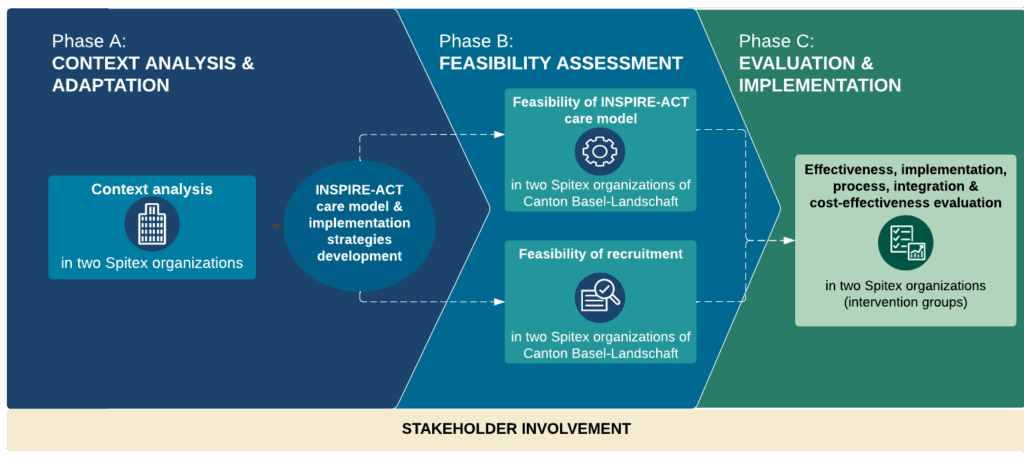
The first phase focused on understanding the specific context, processes, needs, and resources of home care organizations. In close collaboration with Spitex staff across different levels, a detailed contextual analysis was conducted to guide the adaptation of the INSPIRE care model to this new setting.
As a result, a targeted intervention was developed, comprising four core components designed to enhance care coordination and supported by a continuous monitoring system.
Fig 2. Core components of the INSPIRE -ACT Model
In the second phase, the adapted care model is being tested for feasibility in two Spitex organizations in the canton of Basel-Landschaft. This phase examines how well the model can be implemented in routine practice, focusing on its acceptability, fidelity, and reach.
The final phase will evaluate the effectiveness of the INSPIRE-ACT care model in improving outcomes for home-dwelling older adults. Conducted in two Spitex organizations, this phase will focus on key outcomes such as hospitalizations, person-centred care, nursing home admissions, and health-related quality of life.
In addition, we will examine how, why, and under what circumstances the intervention achieves these outcomes, how it improves care coordination for Spitex clients, and how cost-effective the model is compared to usual care.
The INSPIRE-ACT Project builds upon the experience and findings of the original INSPIRE Project, which developed and tested an integrated care model for frail, home-dwelling older adults in Basel-Landschaft. Through this earlier work, we identified key mechanisms of change and the importance of collaboration across care settings.
While the original project was implemented in an Information and Advice Center (IAC), the new INSPIRE-ACT project moves the implementation closer to the community. By partnering directly with home care organizations (Spitex), INSPIRE-ACT strengthens coordination at the frontline of care, enhances fidelity to the model’s core components, and improves its reach among older adults most at risk of hospitalization.
You can read more about the original INSPIRE Project below, while more information and publications can be found here.
Driven by demographic changes in the population of Basel-Landschaft and supported by the introduction of the Altersbetreuungs- und Pflegegesetz (APG), the conditions were favorable for advancing integrated care in the region. In response, the canton partnered with the Department of Public Health at the University of Basel to launch the INSPIRE Project.
The INSPIRE Project aimed to develop, implement, and evaluate a community-based integrated care model for frail, home-dwelling older adults. Its goal was to enable aging in place and delay nursing home admissions through coordinated, person-centred care delivered in real-world settings.
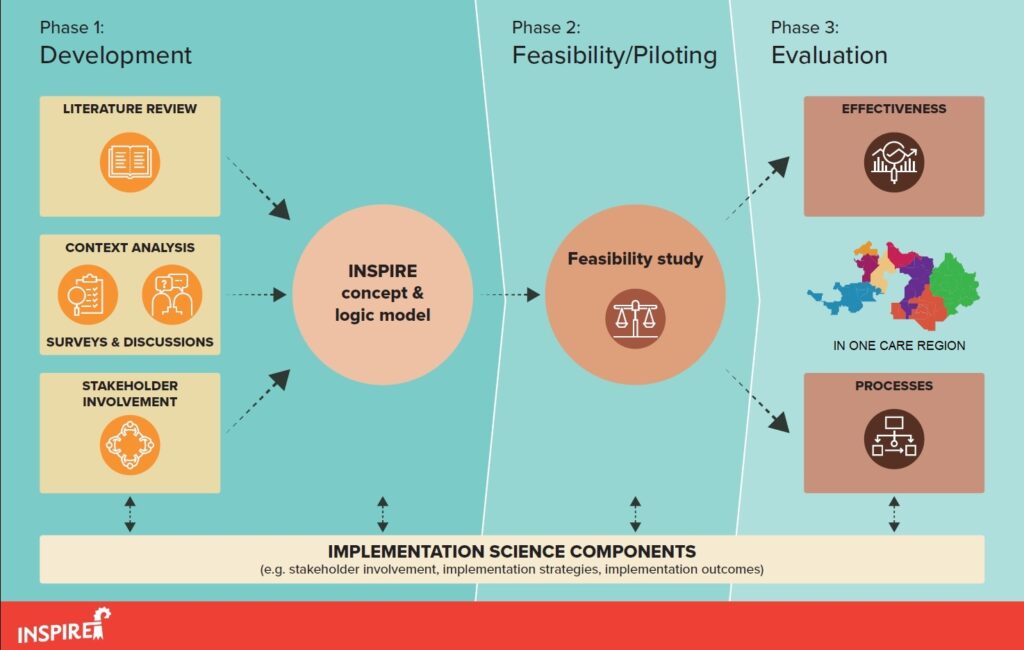
Phase 1 focused on developing the INSPIRE care model, its program theory, and a preliminary set of strategies to address potential implementation barriers. This phase included a review of evidence on the core components of nurse-led integrated care models for home-dwelling older adults (Deschodt et al, 2020) and a contextual analysis (Yip et al, 2021). Contextual data were collected from stakeholder surveys, local, national, and international reports, as well as a population survey of home-dwelling older adults aged 75 and older in Basel-Landschaft (Siqeca et al, 2021). Stakeholder involvement was a key feature throughout the project, with cantonal and local stakeholder groups actively contributing to the development and implementation of the care model.
Phase 2 tested the feasibility of the INSPIRE care model within a newly established Information and Advice Center (IAC) in Basel-Landschaft. The evaluation assessed the model’s acceptability, fidelity, feasibility, and reach. Using implementation mapping, strategies were identified to improve the model’s reach among community-dwelling older adults (Mendieta et al, 2024). The feasibility study showed that, although the model was generally perceived as feasible and acceptable, challenges remained regarding fidelity to the intended delivery and the reach of the intervention to frail, home-dwelling older adults.
These findings highlighted the need for stronger collaboration with community-based care providers working at the frontline to enhance both the consistency and the reach of the care model.
Together, the INSPIRE and INSPIRE-ACT projects represent a continuous effort to strengthen integrated, person-centred care for older adults in Basel-Landschaft and to translate evidence into practice that supports aging in place.